The Outboard Expert: Save Your Trolling Motor
Prevent fuel-oil contamination.
March 22, 2007
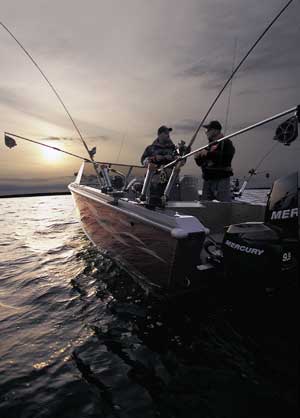
Trolling for trouble? Extended trolling in cold water could fill your kicker's oil supply with fuel.
Is your four-stroke outboard making oil? If you've been checking your oil level and notice that it's slowly rising on the dipstick, you have not discovered a new energy source. But you might have a problem that demands your immediate attention.
My sources at the Yamaha Marine service department brought the condition of a rising oil level to my attention last year. Here"s the scenario:
You use a four-stroke outboard, either your primary motor or a kicker, for trolling. You usually troll for many uninterrupted hours. And you are often fishing in cold water, either salt-water areas in the Pacific Northwest or New England, or during the early season in the Midwest. If you fit this use pattern, your motor could be at risk of fuel contamination of the oil.
Because you are in a cold environment, and because your motor never gets very hot during low-rpm trolling, fuel vapor condenses back into liquid fuel as it travels through the intake manifold between the carburetors and the cylinder head. This liquid fuel dribbles into the cylinder but does not burn, and then seeps past the piston rings into the oil in the crankcase. In the worst-case, the fuel dilutes the oil to the point that it is no longer able to lubricate the engine, resulting in catastrophic damage.
"We have seen a few motors that were ruined because of gas in the oil," said Claude Von Plato, a technical specialist at Yamaha. "But even if the motor doesn't fail, oil contaminated with fuel could cause accelerated wear on many components in the motor."
This is not a problem limited to Yamaha outboards, and Von Plato says he's seen it in motors from 9.9-hp kickers to 115-hp models.
"The severity of the problem really depends on the design of the particular outboard," he said. "If the intake runners are routed so that they pass over a warm part of the motor, you might not have a problem, for example. And if you get the motor hot in between trolling sessions, the fuel that's in the oil will simply evaporate and there will not be an issue."
Motors with fuel injection are less susceptible because the injectors deliver the fuel very close to the cylinder, and it does not have an opportunity to condense. An EFI motor also has sensors that adjust fuel delivery based on engine temperature and other factors.
You should be checking your motor's oil level on a regular basis - and that means weekly, not just once a season. If you notice that the oil level is rising, it's probably a sign of fuel in the oil, and you should change the oil immediately, according to Von Plato.
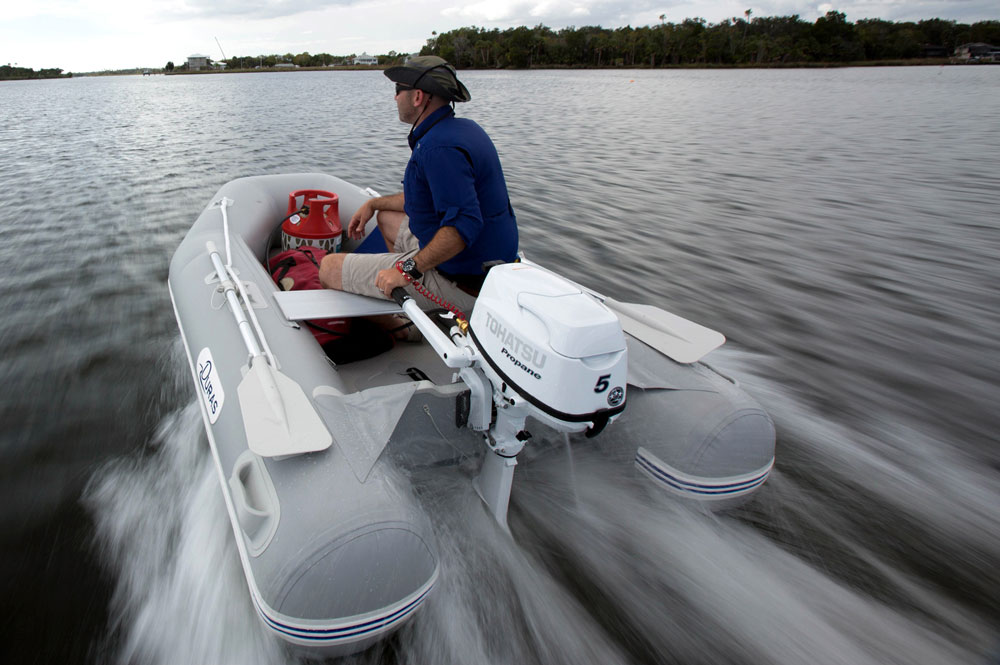
Trolling kickers are the most common victims of fuel-in-oil contamination, because we usually drop them into the water for a few hours of slow trolling, and then tilt them up to run home on the main engine. The kicker never gets hot, so any fuel in the oil never evaporates.
"If it's possible, you want to run that motor at higher rpm and under load, not just in neutral, for about 20 minutes to get it up to temperature and evaporate any fuel or water that's accumulated in the oil," said Von Plato. This means pushing you boat around with the kicker. If that's just not convenient, then check your oil frequently and watch for a rising level.
Bonus Tip: Accumulated fuel, water and acidic combustion contaminates are also the reason you want to absolutely change your outboard oil if the boat will be stored during the winter. Old oil is nasty stuff that can corrode bearings if it's left to sit in the engine for a few months. I change my oil and then kick the motor over for a few seconds with the kill switch off. This circulates fresh oil throughout the motor and flushes any old oil residue off sensitive areas, like camshaft bearings.
Editor's Note: Charles Plueddeman is the editor at large for Boating, the nation's largest boating magazine.